No items found.

Photography by Blossom Berkofsky
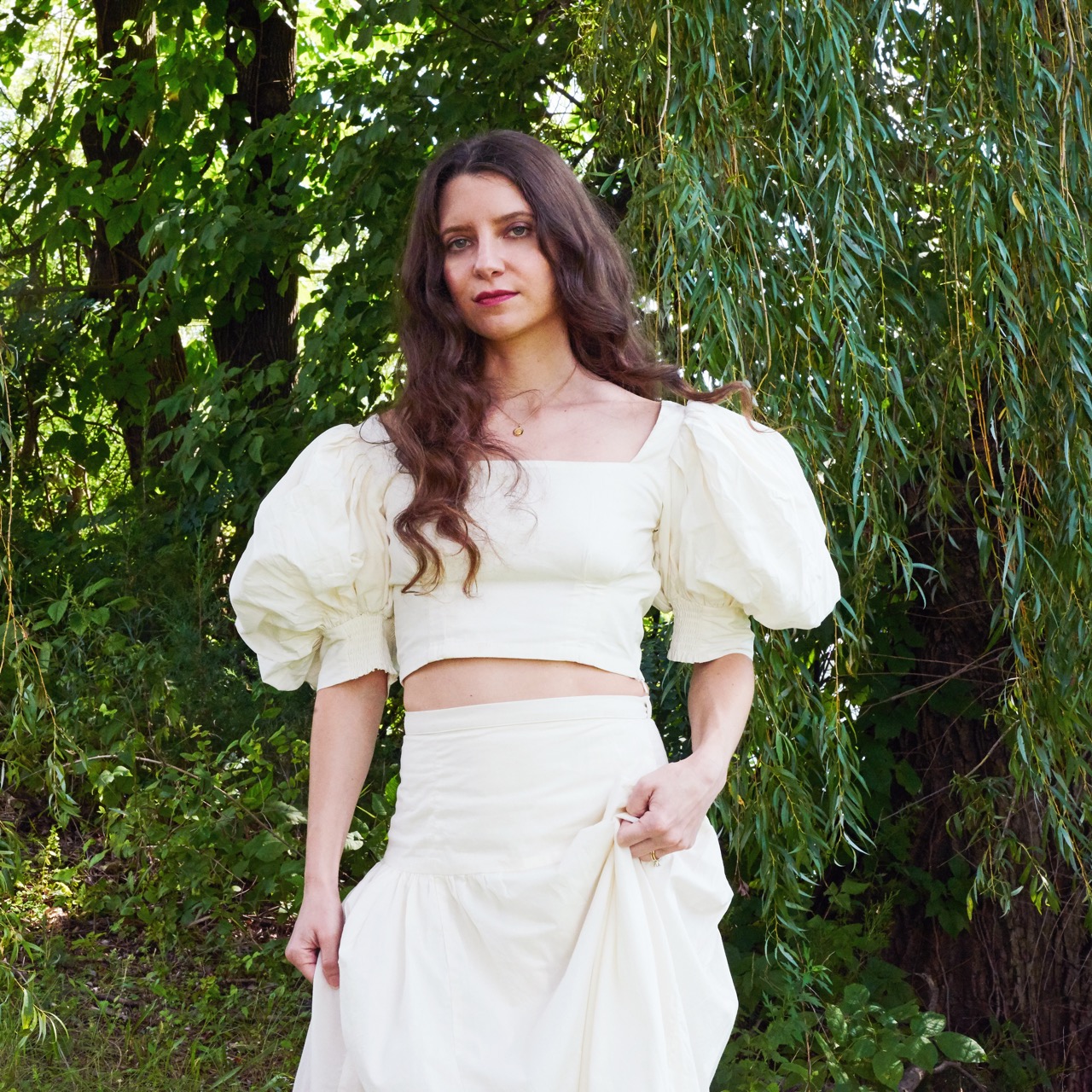
Weaving inspiration from her home in the Hudson Valley and her sharp observations of gender dynamics, artist Emily Coan’s work directs feeling. Born in St. Petersburg, Florida, she’s moved through mediums, landing on a multilayered practice where themes are deeper than as they appear on the surface.
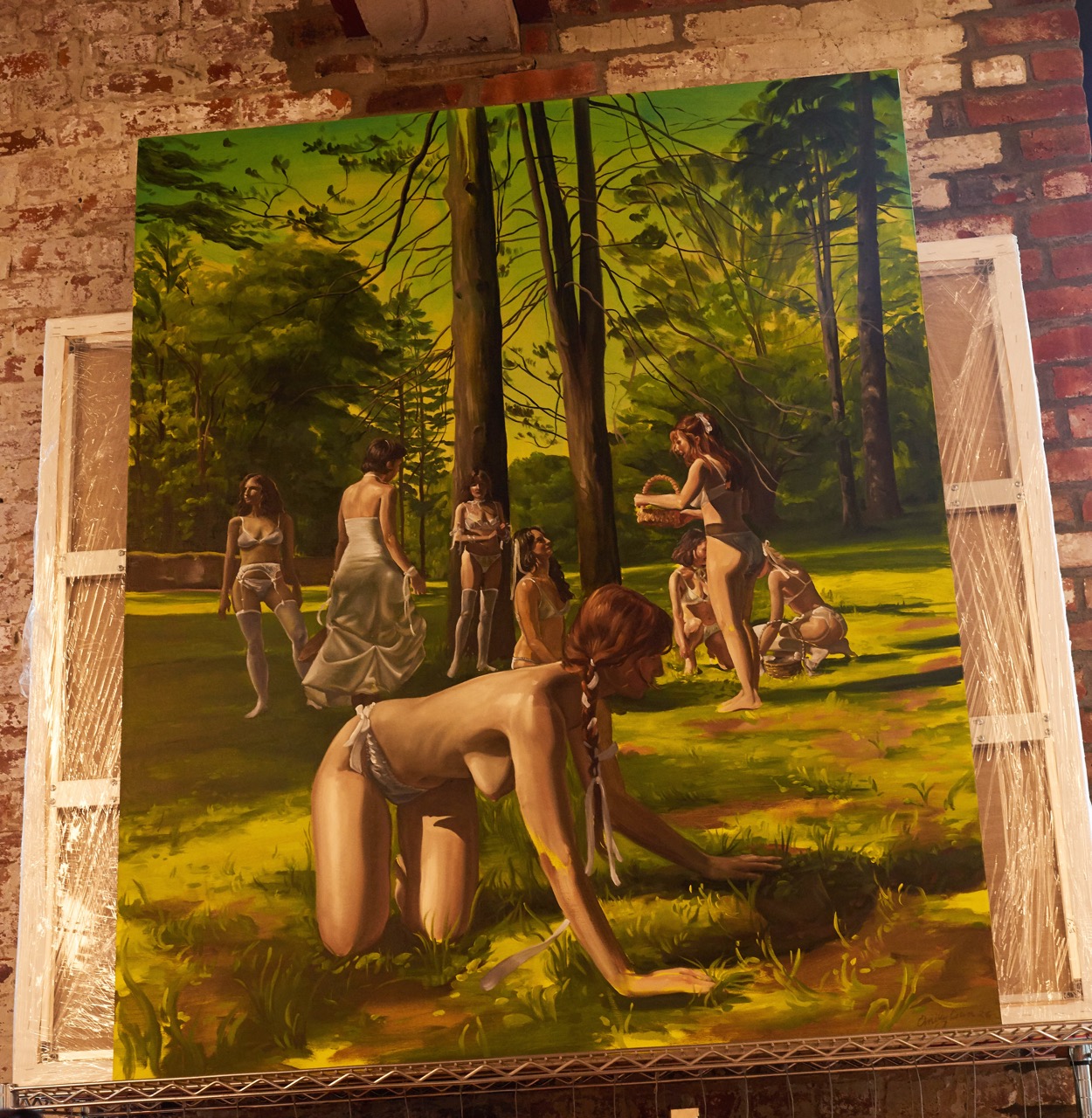
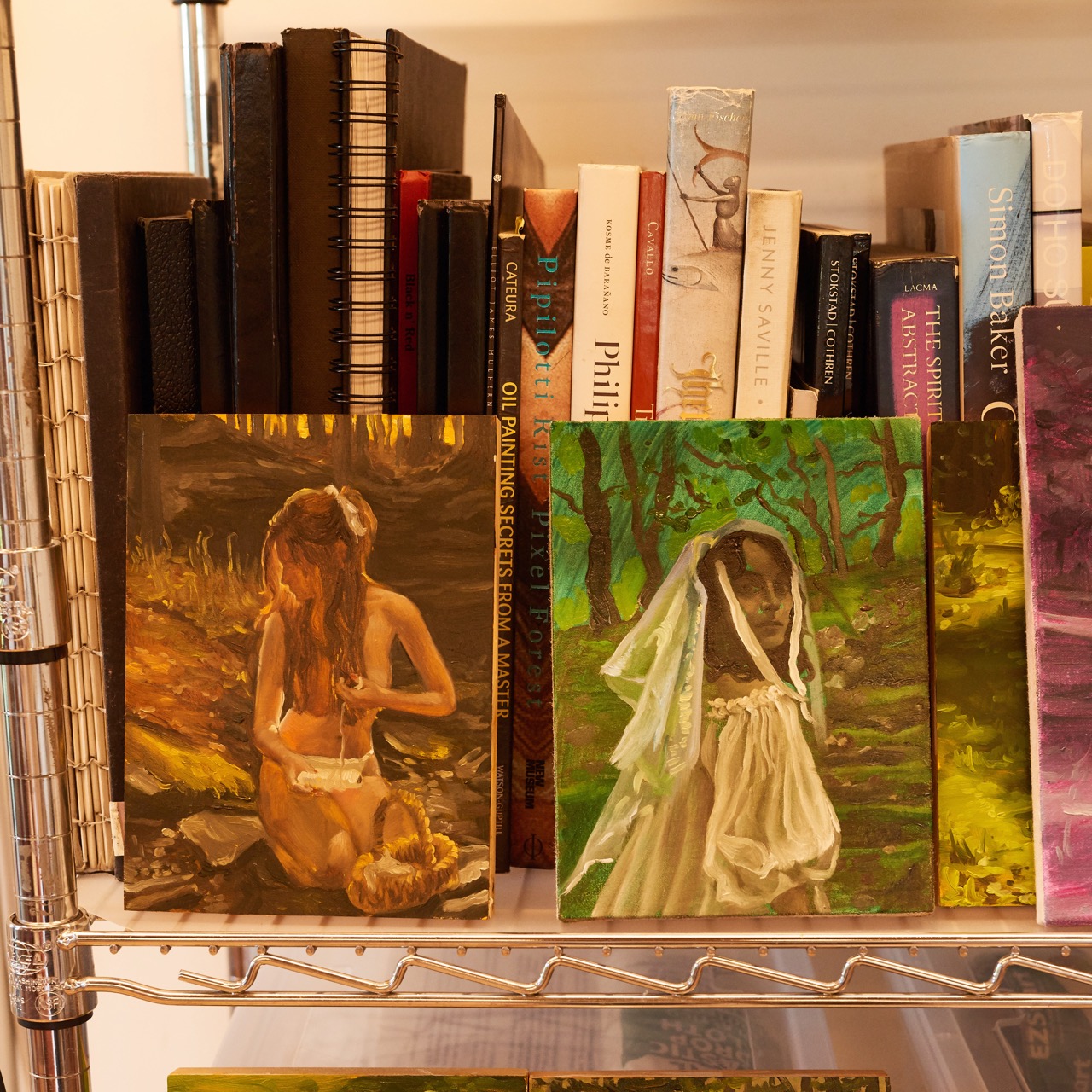
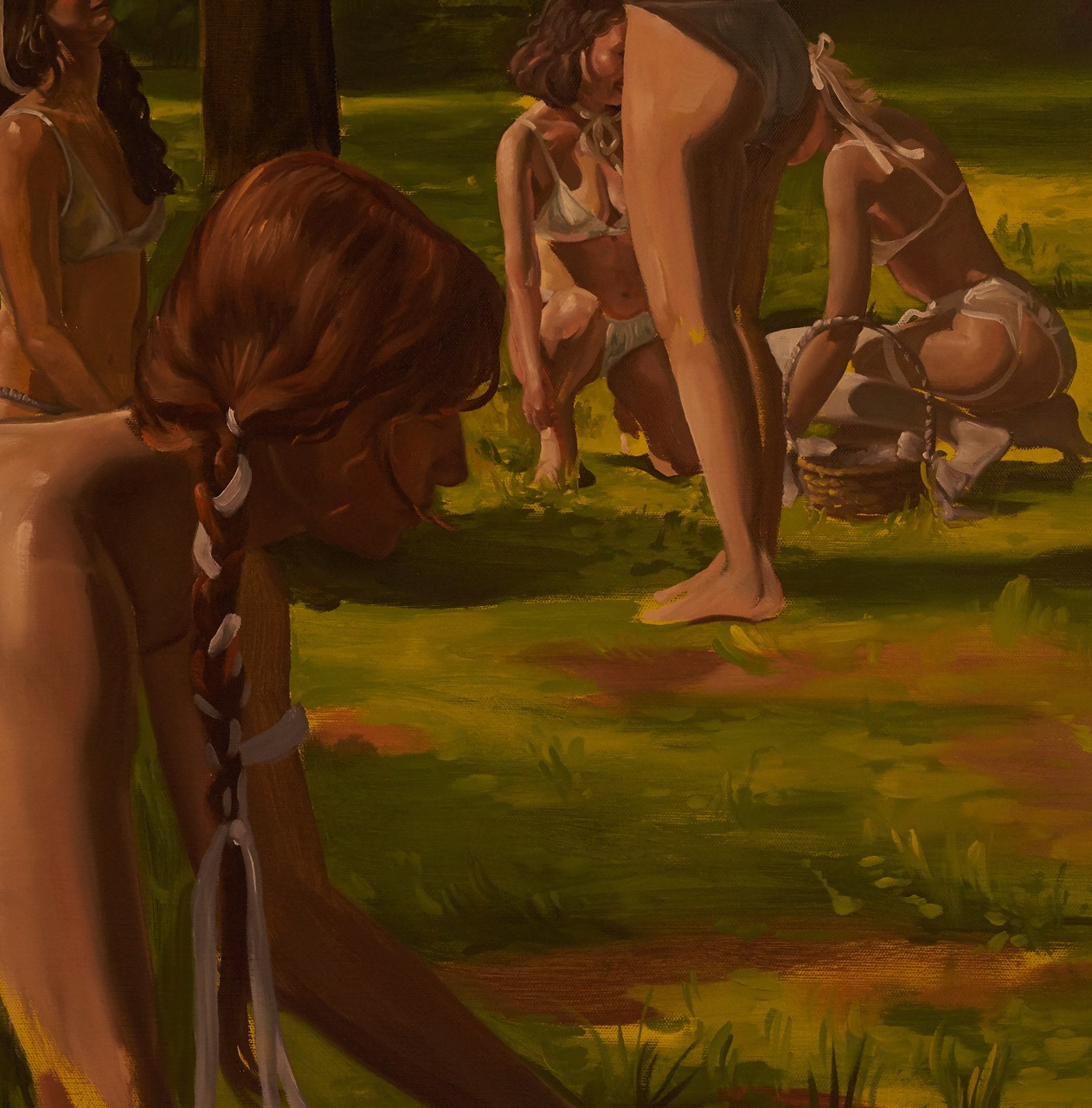
Coan’s been part of several group exhibitions, as well as a string of solo shows including Nightshades at Long Story Short (Paris) in 2025, and a solo booth at The Armory Show, September 2025. Her Spider Silk (2023-2025) series, is “Inspired by the lineage of women as tale-tellers, particularly the weavers of myth and literature, Coan’s work examines the art of creating the tale itself.”
Exploring her creative journey, thoughts on art, culture, and vibe shifts , our rolling conversation revealed more about Coan’s process, curiosities, and the larger, and often ignored narratives, in Spider Silk.
ANTHONY PAPPALARDO: I was curious about this idea of using words to describe images that have been part of your world for so long as an artist. Because I think sometimes the text that accompanies art becomes so reductive. We use words like “idyllic” or “ethereal” to the point where they lose their meaning. So, I’m interested in how that feels from your perspective.
EMILY COAN: Going into any body of work, I basically write a press release for myself before I start. I have references, and I’m very direct about what I want. I write a PowerPoint to send to the participants and it’s very direct. It’s got a lookbook in it, it’s got a story, it’s got references—everything is there. Then the gallery takes it, and I think they make it a little more flowery. Honestly, I didn’t even read the one for Spider Silk. [laughs]
Whoever gets that PowerPoint must be so happy. They have to be. You’re giving them a concrete starting point.
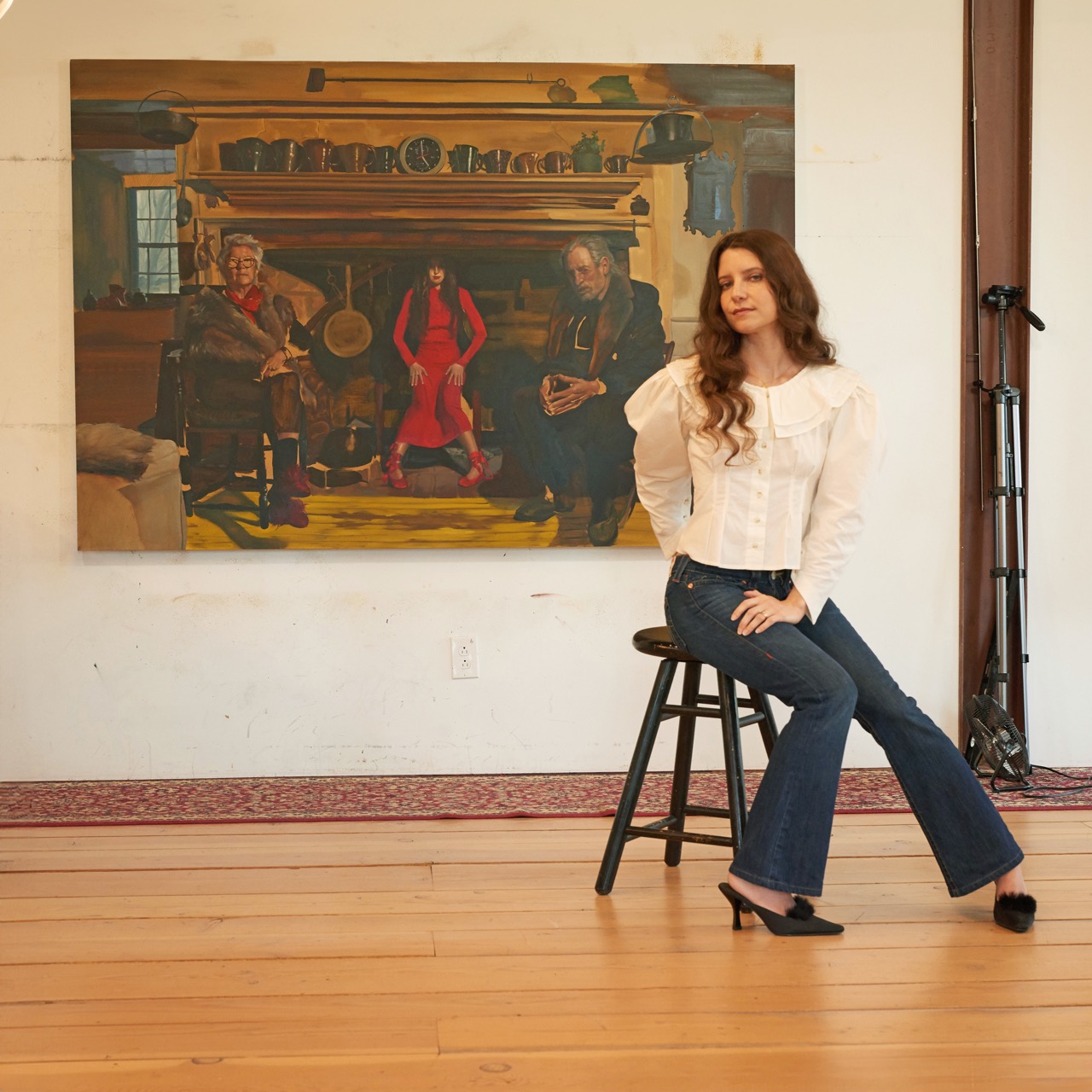
Now that I’m painting people—I want them to really play in an environment that’s very carefully created. I almost feel like a director and we have to know what the script is. There’s room for improvisation; room for people to bring their own personalities into it. But I’m actually kind of a gifted writer—it’s not something I’ve done anything with, but it makes it a lot easier to be an artist because I can very directly express what I’m trying to say. I went to art school for undergrad, but I didn’t go to grad school because I don’t love that culture of, “Oh, I have my own personal symbols that don’t actually reflect back to anything, and I’m just going to jig it up with some art speak.” That’s not interesting to me. I’m like, why are we all giving so much time to this? I feel like the more punk rock thing would be to ask, “Where does this touch down to earth?”
I often wonder if it’s just how our institutions work. When an artist is successful, they can attach any story after the fact. You could say it’s about your challenging childhood or a pivotal trip to where your ancestors were born. It doesn’t fucking matter. You’re already selling a painting for a million bucks. But before that, what’s a good or bad story?
It’s also just so interesting what the market chooses to call “good,” and so much of it isn’t actually about the art. But I think that makes sense, because there’s so much more going on—the art is like a symbol of everything else, whatever that person represents to the collective or the art world. But for me, it has to come back to the work. The work has to be good. That’s how I’ve always operated. When I moved to New York, I wanted to make it as an artist and I looked around and thought, “My work’s not good enough to be in galleries, so I have to work on making the work good before I can really go for that.”
What wasn’t good enough to you?
There were just a lot of technical elements I felt needed work. Actually,the first thing I realized I needed to work on was composition. Now composition is the most important thing for me.
What’s your approach to that? Composition is almost the “math” of image making and I can see a lot of creatives pushing back on the idea of the “right” way to compose something.
What really helped me at the beginning was working in the same ratio every time. I wasn’t applying the “correct” golden ratio, but there’s this drawing I do where it’s like an “X” and from each corner and it goes to the middle, so it makes this star-looking shape. Having that guide there made me feel like, okay, this is where things are pointing inward or could be pointing out. My compositions now, especially when they have more depth, flow a lot more. I’m always looking for a flow that’s happening and I still draw that guide every single time on the canvas before I put a drawing down. It’s just something that grounds me.
That’s very much like a film director composing a shot.
My background’s in sculpture and photography—that’s what I studied in undergrad. I didn’t do painting. I wanted to be a painter, but art school convinced me painting was dead. They were wrong. I actually wanted to make films, but then I worked on one film and thought, no.
Was it too many moving parts? Too many personalities?
Yeah, I’d love to do that maybe in the future, but the collaborative part of it is something I wasn’t ready for. We actually ended up doing a short film in Florida, where I lived, and my collaborator refused to put it into any film festivals in Florida, which was sort of the whole idea. We said, “We’ll just make something and do film festivals in Florida,” it’s not a big deal. He wouldn’t do it because he didn’t want his name on it and I thought, “I can’t fucking deal with this. I need to have the power to release something.” That’s when I decided filmmaking wasn’t going to work for me.
Your recent work feels like snapshots of something larger—like I’m filling in the blanks of what led to this frame I’m seeing. How long did it take you to get to that point where it feels like filmmaking, coming from sculpture, which is traditionally a stagnant 3D medium?
Mine wasn’t. I was doing video installation and performing within installations, and that’s what I did in school. Then I went to Art Basel for the first time, and I thought, “I can’t sell this.” I’m very practical—I’m not coming from a family where I can afford to not make money in the art world. I have to be a market artist. So that’s the path I chose and I was thrilled to see so many paintings there. I think it really became filmic for me with the Spider Silk series, because that was the first time I brought actors onto the stage. In the past I was just painting from memory, because I thought, “We can’t use photo references. !hat wouldn’t be punk rock!”
Then I finally got to a point where I realized if I used photo reference, I could make really fucking good paintings. So I started doing that. It didn’t feel like film while we were making it—it felt like everybody was playing pretend in this story and that was so fun. That’s kind of been the vibe since then with the new series too. It’s like entering a world.
What was the first Art Basel you went to? What year?
It was 2012. I was a senior in college, and we took a bus from Gainesville, Florida, at 6 a.m., drove down to Miami, stayed for about eight hours, and drove back that night.
So you didn’t have the famous “What u tell people ur doing at Art Basel vs. what ur actually doing at Art Basel” meme experience, with Pepe the Frog doing coke?
[laughs] No, I was on a school bus. They had us go to preordained things—we went to the Rubell Museum, Wynwood, Art Basel itself, and I think Scope.
Nice, so you actually got to see art, how novel! [laughs]
I did go to Art Basel a couple times as a Florida resident,and we were trying to get into those parties, but we didn’t have the connections. We were coming from St. Petersburg, Florida and staying in the bikini hostel.
2012 might have been the first Basel I went to and it very much felt like New York nightlife transplanted to a beach with a bunch of gaudy activations and very little art. I don’t want to discredit the amazing work there, but it felt like a three-day Super Bowl party more than an art fair. What happened to the actual game, you know?
I wonder if that’s shifted at all. I went there and showed at Nada in a group show with my gallery in 2024 and it was not a good year. Everyone was saying it was the worst year for going out ever… and it sucked. I didn’t feel like the good times were there. I don’t know if that’s over or what, but it was kind of gross, honestly… so intense.
Maybe I just missed it. I did go down right before I moved to New York, in 2014. I got a ride with a friend of mine from Florida who was driving down with some New York gay party boys. When I moved to New York, I became a codependent best friend with one of them and started going out to all those scene parties. I figured out that scene wasn’t for me after going out with them every night for six month and someone finally said my name for the first time. “I thought, I gotta go. It took six months for you guys to acknowledge me after spending time with me every night?”
Maybe part of that shift is the art world being in “Woke 1,” and reckoning with the fast that they needed to clean house. Maybe they used a little too much bleach, but it needed to happen. Like, why are we giving a creep like Terry Richardson a show again?
The 2010s were so hedonistic. It was crazy. It was fun. I probably remember it as more fun than it was. I was such a mess, I was so fucked up. And it was cool to be like a disgusting, drugged-out mess. And then, of course, that has to swing the other direction. That’s just how it works.
In his interview with Hunter Biden, Adam Friedland said (paraphrasing) that America got incrementally worse every year after 9-11. I get what he was saying, but New York City started to give less fucks, everyone was escaping, VICE becomes this corporate empire, and New York–in full nihilism mode–becomes “the center of the world” again or whatever. You can only go so hard for so long, then nature comes along. Maybe COVID forced everyone to shut down.
For me there was a giant vibe shift in 2016 with Trump getting elected. I was 25, and that was a stark difference between the optimism of the Obama years—feeling like everything was taken care of to feeling like there was danger looming. I don’t feel like we’ve recovered since then. I still think everything has been a lot more intense since then.
I really do feel like Trump as a figure ushered in the end of art and almost the end of “concepts.” The first big moment is the “pussy hat.” It had to happen, but it’s so literal, then you get more protest art that’s very direct: Here is a painting of Trump as a baby or in a Klan hood. But rich people don’t want to buy protest art–tech people hate art, so they move to NFTs, which failed. It felt like a quiet dismantling or devaluing of art… but I’m also making this theory up on the fly. [laughs]
My off the cuff response is that there’s probably a reckoning with everything that happened when he got into power and since then we’ve been trying to figure out who we are. There’s real suspicion about high versus low and I think some of that’s valid, but I also think there’s no death of art. Art’s eternal—we’re always going to make it. Even though the market feels scary now and people are dropping like flies out of the art world, leaving full-time art to get other jobs. I get it. But I think there was this optimism, and during COVID there was speculative buying that kept people afloat. I didn’t have any money because I was just starting out and now, after a couple years of good sales, the market is crashing again. It feels clear to me at this point that this is actually what it’s like to be an artist—this is what all the older artists were talking about. It’s just up and down and art is the first thing to go when money constricts; when there’s not liquid money going around. That’s just what it is to be an artist. That’s why there are so many trust-fund kids as artists. You kind of need to be floated during these tough times if you’re not making it on sales alone.
I think that’s just where we’re at right now. I think art will come back. And that stuff, like Trump as a baby… sure, it’s art, but it’s like cruise ship art. You know, I love cruises, and I always go to the art auction on the cruises, but I don’t think it carries the same intuitive message that somebody channels.
Right, cruise ship art isn’t probing anything. When you’re reacting, there’s a tendency to make reactive art, versus exploring an idea. Maybe we’re getting back to the point–because of the economics and reality of Trump 2.0–where ideas are necessary. Maybe there’s more of a reason to think.
I agree with that, because I experienced this myself a little firsthand. I had a surprise, amazing show in New York—my first show ever. It was insane, I got plucked off Instagram. People thought I was showing everywhere, but I wasn’t, I’m just gifted at marketing myself. So people thought I was showing everywhere, and I got plucked out of obscurity and put into a show at Kasmin Gallery, showing in the same room as Cecily Brown and Lisa Yuskavage for a summer group show. I absolutely choked after that.I had to go to therapy. I also only had two good paintings; I didn’t really know what my work looked like yet.
Then I started getting a couple shows, and I had a show with Unit London in 2020, right before the pandemic. I did a studio visit with them and thought, “All right, this is my chance to go full corporate artist. I’m just going to do the thing that works, that’s making money, that people like.” I remember having this vision of myself in a neon ’80s suit, like I was going to be an evil capitalist artist. Then COVID happened, everything shifted, and I moved Upstate. Every time I’ve tried to go down that path (of making commercial work), it just doesn’t work for me. I don’t know if that’s some kind of spiritual thing, but I can’t go full evil corporate.
What do you think it is? I wonder if it’s the physicality of it—you can’t commit to the physicality of actually doing something because you’re not fully behind it. It’s almost like watching an elite athlete fail. They’re so good, they must have blown it because they weren’t mentally there at that moment…
I think it all comes back to something spiritual and mental. It’s like Simone Biles getting the twisties, when she couldn’t do her routines anymore. There are certain reckonings that get in the way. I do have this crazy psychic—the kind who will blow you away with insane insight. She once told me you have to be removed from the art world to a certain extent, because you need to be in the channel, and you can channel from Upstate. She said, “Look around at all these successful artists. How many of them have been compromised?”
I thought, “Right, how do you become successful and still keep your foot in that channel?” For me, I need a lot of space and time and quiet, and ideas drop down into me. That’s what I use. I have to wait for the idea, and I have to get quiet enough for it. The corporate baddie in the neon suit isn’t doing that, but I don’t consider myself a psychic either.
I marvel at anyone who can get ideas in New York City, given how much stimulation there is. When I lived there, I used to walk around the Upper East Side on Sundays because it was so dead. That was the only way I could slow down without going into nature.
People always hate on the Upper East Side, but if I were ever to get a pied-à-terre, I’d honestly be there. I like the Upper East Side—I feel like it’s spacious. I like it. It’s a funny place. I also feel like it’s just so entrenched in its own culture, that you can kind of be on the outside of it.
I was talking to a friend of mine, a painter in L.A., who said he used to walk around the Upper East Side trying to see what art people had. He’d trip out because you’d see something and think, “That’s real, they actually have a fucking Rothko in that brownstone.”
I remember one of my first experiences after moving to New York. My parents had a friend who was a restaurateur. His parents were wealthy and gave him money to open restaurants in St. Petersburg, Florida. They’d have a big splashy opening and then the restaurant would fail after a couple of years, and they’d give him more money to open something new. I went with him to his parents’ townhouse on the Upper West Side, maybe my first two weeks in New York City, and it was fascinating. I didn’t know people really lived like that. It was totally filled with fifteenth… maybe sixteenth-century Spanish art that they’d collected. They had three floors and one painting spanned all three. The second floor was like an art gallery and the bedrooms were upstairs. Looking back now, I think, that’s probably an old-money, conservative family.They collect their things and contemporary art is a whole other story, because it’s even more expensive.
And fine art was always a “clever” way to hide money, before crypto. I’m not sure what it means for art when the nouveau riche are much better at avoiding taxes.
I can’t really speculate. I don’t know what’s going to happen with the art world. I feel very guided by my own intuition and by what I’m being told to do. This path has just been the only path for me and it’s been so strong that I know I have to do it. It’s also interesting because people say the traditional gallery model doesn’t work, and blah blah blah, and I think that’s largely true. There are a lot of problems and the whole system is kind of breaking down. It can’t keep supporting as many people as it has been, in that kind of model. But for me, I just have the sense that model could work and I think part of it is the nature of the way I work—the fact that it reaches back to that older style of painting, more canonical, museum-like.
I also think that over the last twenty years, we’ve been a little too caught up in critiquing all these legacy institutions. But at the end of the day, a bank is a fucking bank and a museum’s a museum. It’s when those institutions try to over-correct and modernize. I’ve never once been in MoMA thinking, “Oh, I’m going to scan this QR code!” Fuck that. I think the bells and whistles we put around things distract us from what’s actually happening. The clientele of a traditional gallery may change, but the concept won’t. I don’t know, all I do is look at bullshit on my phone, and it’s not fulfilling. I want to see it.
Seeing stuff in person is so important and that’s what kills me about even the current gallery model—shows are getting shorter and you really have to see things in person to understand, because there’s something you’re imbuing into the work by spending so much time with it, and that’s real, beyond just looking at a painting on a screen. My paintings are huge and on a tiny screen they look very resolved, almost photographic, but in person they look a lot more painterly. You can’t really share that with people unless you share a million tiny details, and it’s just not the same effect. When I moved to New York, seeing things in person was the craziest experience for me.
Do you remember Hi-Fructose Magazine? I saw a show of that kind of work that looked really good online, and then saw it in person, and thought, “This is doing nothing for me.” I’m generalizing, but it was that kind of illustrative style. Then going to an actual gallery and seeing something—maybe not my favorite type of painting—but seeing how well done and confident the marks were, I thought, I need to get to that.
I’ve had almost the opposite experience—some of the paintings I’d seen in books or in slideshows in art school for decades, then seeing them in person and noticing how the painter would fix an edge or whatever was amazing to me. In my head this was so perfect, but seeing the humanity of it made it more perfect to me.
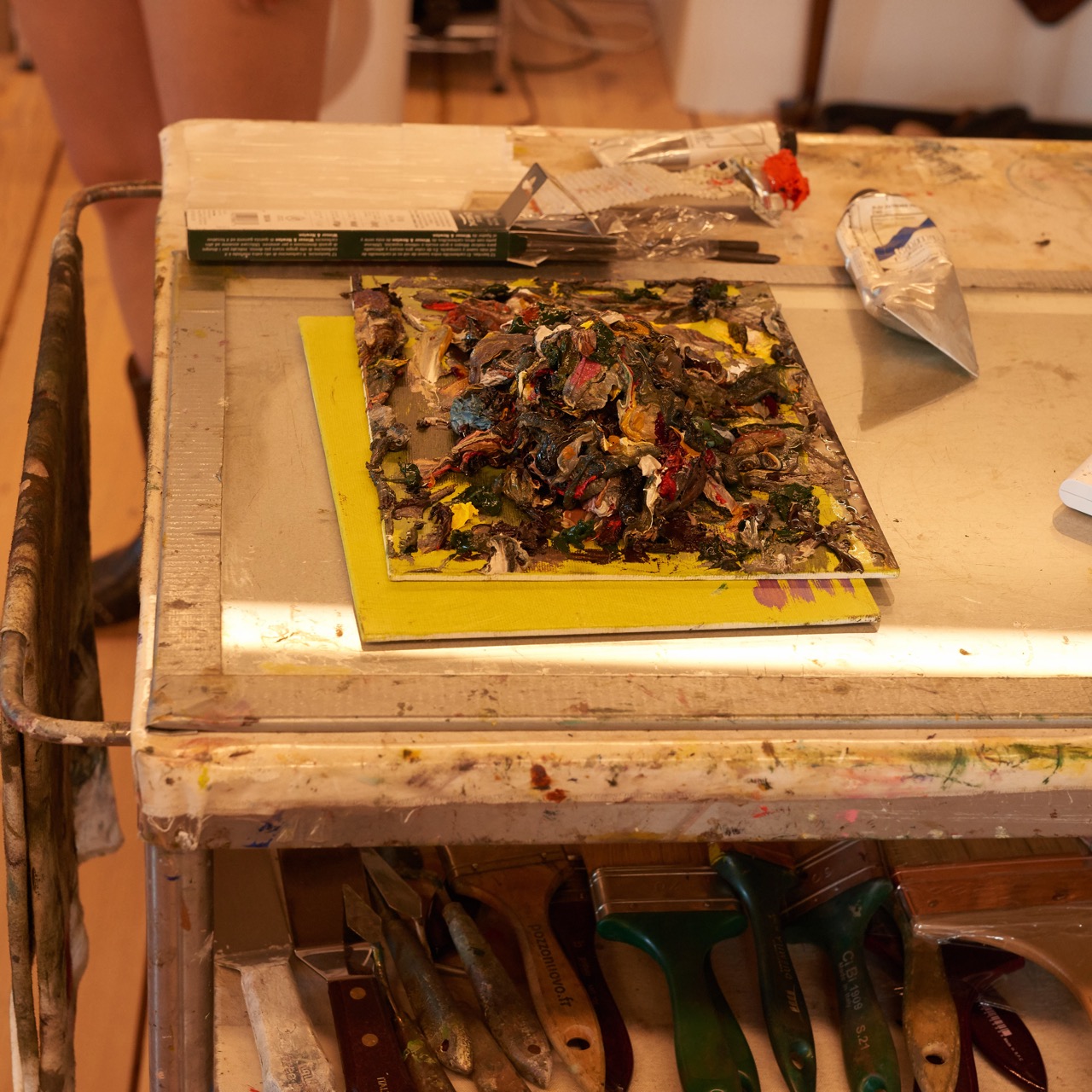
That’s why it’s good—it’s done by hand. I think people sometimes get too slick with it, especially with figurative painting. I’m dealing with that right now. Yesterday I was taking a lot of risks on a painting, applying paint thickly and moving fast, and it’s scary, because you could sit there and render it and it would look good, but there’s so much at stake when you’ve put weeks or months into a painting that’s already a banger, and you’re doing something risky. I was hardly breathing yesterday, hoping it would work out. Often I’m a wipe-away girl—put it down, wipe it away if it doesn’t work, keep it fresh. Is there something you have to have the discernment to know: “am I at a wipe-away moment, or do I need to give it thirty more minutes and let it magically work?”
Can you step away from things—I’ll give it a day or no?
That’s my favorite thing: when I’m fully loving painting; to be able to step away. Unfortunately, I haven’t figured out how to manage that lately. I have a show coming up in October and I’m doing ten-hour days in the studio, five or six of those painting. At this point it’s more stressful, because everything has to work. It is weird that when everything has to work, it does work. But it’s intense.
That’s biggest benefit of being in any kind of model: the deadlines.
There’s something to say for that, because when you don’t have that, you can just continue to tweak something forever, and at some point you just have to shit or get off the pot.
And then you get the feedback. That’s one of the biggest positives of formal training—those first moments when you present something are very powerful.
I 100% agree with you. I almost feel like I don’t really know what my work looks like until it leaves my studio. Then I can really feel what it’s like. There have been so many times I’ve had a painting and thought, “I don’t know about this,” and then you see it installed and there’s something that’s really working with it. You have tweaks, you look at stuff, and think, okay, that’s not working so well, this is. I think closing that loop and showing the work is such an important part that people don’t really talk about.
Going back to seeing work in person, one of my favorite things was to wait for the first snow in New York and then go to Dia:Beacon, because the snow would extend the gallery—it felt like a bonus experience, like I was in this blank world with these images and pieces.
That’s funny. I never thought about that. I’ve never been to Dia:Beacon.
I think there’s something to the idea of being in New York City, around all these institutions and incredible galleries, then getting on Metro-North to Beacon. I don’t want to say it’s a novelty, but it’s a whole experience. And if you have a car, it’s a road trip.
One of my first expeditions out of the city was to Storm King. That was cool, but it’s funny, because people leave the city to go look at more art. I find New Yorkers so funny now that I don’t live there anymore—there’s such a gravitational pull to be in the city that getting out of it, you’d think you have to be launched into space to leave. Even going up to the Hudson Valley, it’s hard for people to get out of the city, and then when they do, they just act like they’re in the city somewhere else—still doing ten things a day. Don’t you guys want to let your nervous system relax a little?
The first time I went to Storm King was one of the worst experiences I’ve ever had, because I went with a friend who was really into “dude art.” He was mansplaining Andy Goldsworthy to everyone and talking about how he was really into “cement.” I remember the drive home thinking, “Fuck, I need to look at less dude shit, asap.”
I think that’s interesting—I’ve felt like that too. I think the feminine perspective is becoming more interesting to the culture at large. In feminism, we’ve kind of grappled as a society of women with how to succeed in a male-dominated social sphere, and this is also part of my research right now. I’m making a series based on my in-laws’ house, which was built in 1780 or 1790. It’s this old farmhouse, and I’m really interested in what the culture was like back then. At the time the house was built, society was patriarchal, but the culture, the home, and work were all very intertwined. The patriarch was the head of the household, but he was held by all these constrictions of society; it wasn’t just what he said. Everybody was more on equal footing. Then, when industry started happening, to grapple with this competitive, uncertain future, women took the moral high ground, which was more valued in that patriarchal society, and took the home, while men went out into the world to do this competition. It’s this interesting shift—home used to be work. They were the same thing and then men started playing in this cultural sphere, and because of that the shift of power went over there, and women had home, religion, and morality. Then, all of a sudden, women were totally dependent on men.
I feel like women have been trying to enter this social sphere that’s been dominated by men, so women have been acting like men to get in there. But there’s something about femininity in and of itself that’s very interesting and has been super suppressed in this culture, and it’s been reacted to extremely poorly. People don’t know what to do with it, people are super triggered by it. I feel like that’s where my work is. There’s an appetite to give voice to some of these more feminine interests, to see what it’s like to make work and be in culture as a feminine-feeling energy, as opposed to a masculine-feeling energy wearing feminine drag.
How do you define femininity?
This is really simplified and it’s really difficult for me to put into words. I think the height of masculine energy is being able to hold the chaos of feminine expression—almost like a symbiosis that can work together. This is going to sound so insane, but feminine energy is like a spiritual channel. Women often know things, and I’m not being super rigid with gender here, but there’s a feminine knowing that people have—a connection there. I think the feminine can receive this stuff and the feminine is a little chaotic. It has to try thing and there’s this cycle with the moon, so there are lots of fluctuations.
I think the feminine points to where we’re going, and the masculine holds it and grounds it down. I know that’s really abstract, and it’s almost not even what I talk about in my work directly. In American culture, the masculine is more about ambition; the individual, providing everything for the family, being very competitive and the feminine is more associated with nurturing, community, and care. I think the culture is becoming more interested in stories of care and those kinds of expressions. There are so many things ricocheting around in my brain right now—even Joseph Campbell’s linear “hero journey.”
There are a million ways I could answer that, and I think about it all the time, but I think about it almost as an energy that I’ve yet to be able to explain.
Maybe we just took things full circle, because we’re back at words around images. [laughs] One other thing I wanted to ask you was this idea of the “antihero.” Typically, Americans love Tony Soprano, Tony Montana… fucking Walter White in Breaking Bad, which was essentially the same idea as Weeds, right? But “we” don’t accept female antiheroes as much as male ones. It’s like American culture still isn’t ready for that.
That’s really interesting and I think it definitely dovetails with my work, because I get so much pushback—you just can’t do anything correctly as a woman, especially if you’re touching on anything around beauty, sexual power, sensuality. If it even touches that, and you’re not within certain “woke” guidelines of identity, there’s a lot of blowback, and it’s divisive. I think Lena Dunham is a genius for her work on Girls—it’s interesting that she wrote characters that really exist, flawed feminine characters that feel so real, but people hate her as a creator, and they hate the show. I find that really interesting, because to me this is a genius voice really describing flawed characters, and I can still root for them. I’ve always been super feminist, even though people use that as a weapon against me, “you’re not feminist enough” or, “you’re a fucking feminist so you’re using that to cover this or that. “It’s like if you engage with almost anything as a woman that’s not within this narrow set of parameters, you’re a heathen.
Right, it’s a tired attack that we all see coming, yet it gets used over and over.
I’m still shocked at the way I’m critiqued for using the word “feminism.” It’s damned if you do, damned if you don’t. Some of the feedback I got from my last series, from people who resonated with it, was such a joyful experience. That was one of the best days of my life, when we shot that series—it was very positive and it wasn’t sexual, it was a sensual thing. I think what people don’t understand is that they look at the work and see certain cultural touch points they’re supposed to see, and then they make a judgment without actually engaging with it at all.
For me, this work isn’t just about community and friendship—there’s so much competition between women, and I grew up in an environment where friendships were competitive, especially in the art world. I wanted to make this beautiful story where there are women weaving outfits for each other, like spiritual garments, to get to the next realm. That’s where it came from. There’s no main character—they’re all in it together the whole time. It’s about this grouping of people, about feeling pretty and being dressed up in these holy garments, almost, because everyone’s wearing white. The other fantasy that literally nobody’s talked about is the fantasy of being able to move about freely in the woods, in the environment—a longing for the commons that used to exist, the sadness about the privatization of land, the real embodied feeling of being in the country, and realizing you can’t just walk through fields.
In America, people have guns. Where can you actually be topless and let water fall over your body in America? You have to own that property to do that. It’s a very exclusive thing or you have to be punk rock and go out in the woods and risk it. There’s a fear about trespassing. The way we interact with the land is so mediated by the state—we’re walking on a single path. They’ve installed park rangers at the local waterfall where I got engaged; you can’t even go down there anymore. That’s so much a part of this work for me and literally nobody has ever said anything about it. There’s more there besides what people see. They see women in lingerie and suddenly it’s, this is pandering to the male gaze. To me, it’s the ultimate female gaze.